Dana Hartmann · 15 October 2026
Assessing Quarry Extraction Techniques and Their Role in Shaping Vein Distribution Within Marble Slabs for Custom Architectural Projects
Quarry extraction techniques determine how marble blocks release from the earth and how their internal vein structures translate into finished slabs for architectural use. Data from geological surveys shows that methods such as diamond wire sawing and controlled blasting produce distinct fracture patterns which in turn influence the orientation and visibility of veins once slabs reach cutting facilities. Researchers note that vein distribution becomes a critical variable when designers specify custom patterns for walls, floors, and feature elements in high-end projects.
Primary Extraction Methods Used in Modern Marble Quarries
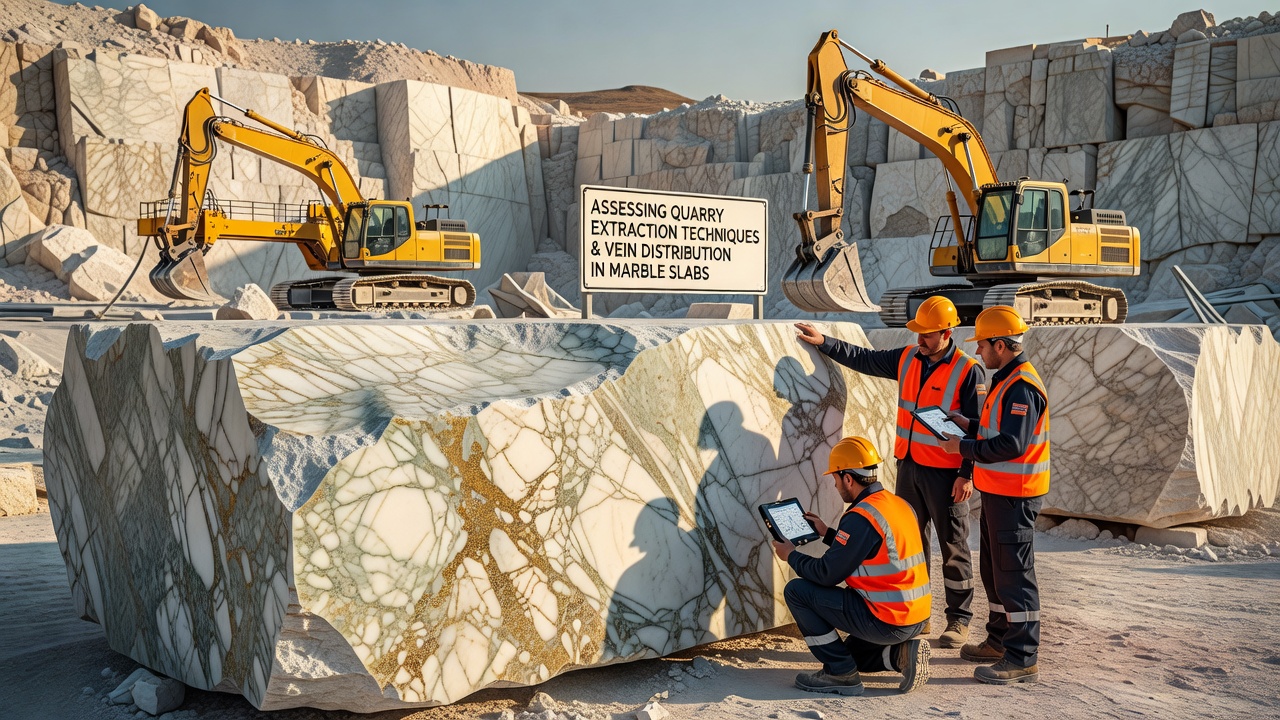
Diamond wire sawing operates by threading a continuous loop of wire embedded with industrial diamonds through pilot holes drilled into the rock mass, and the wire travels at speeds between 20 and 40 meters per second while water cools the cut and removes slurry. This technique creates narrow kerfs that follow predetermined planes, allowing operators to align cuts either parallel or perpendicular to existing vein systems. Controlled blasting, by contrast, employs low-velocity explosives placed in drilled patterns to fracture the stone along natural bedding planes, and operators adjust charge sizes and spacing to limit micro-cracking that could intersect veins at unintended angles.
Water-jet assisted methods have gained adoption in several European operations since 2024 because they combine abrasive particles with high-pressure water to slice through marble without generating the heat associated with older mechanical saws. Studies from the United States Geological Survey indicate that water-jet cuts preserve vein continuity more consistently across large blocks compared with traditional chain sawing, particularly in marbles containing calcite veins of varying hardness.
How Extraction Choices Alter Vein Orientation in Resulting Slabs
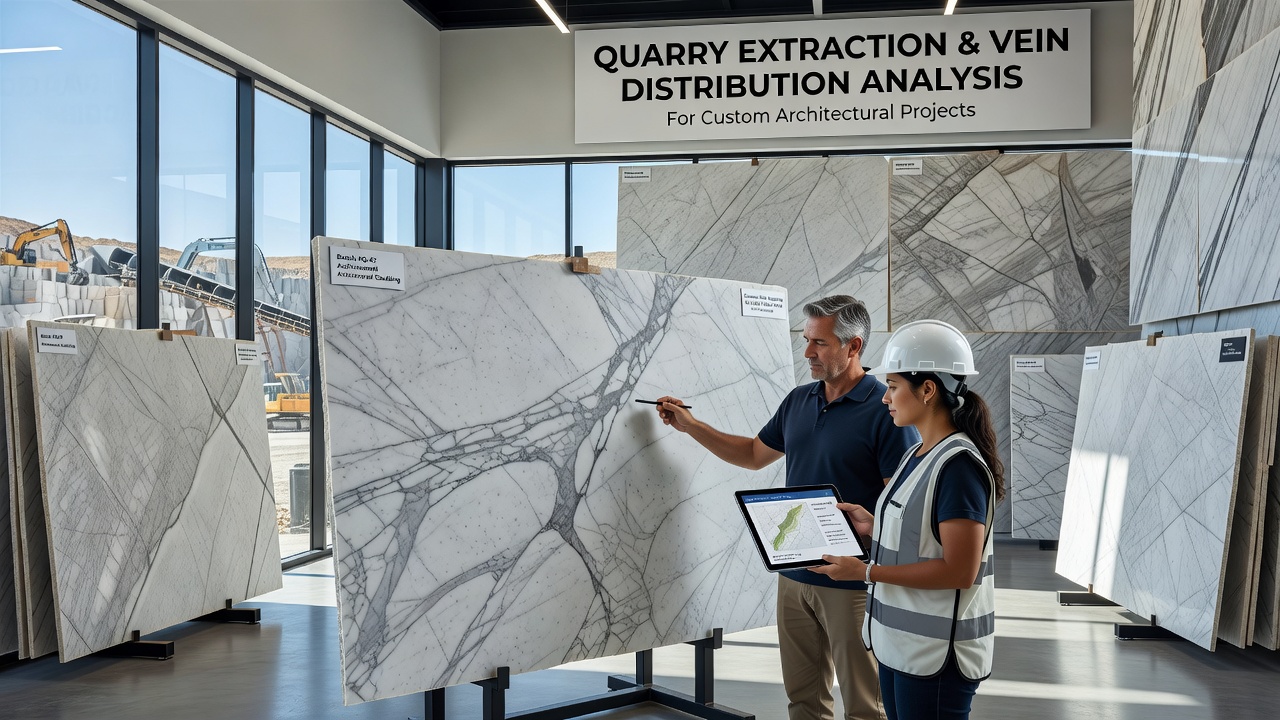
Veins in marble form through mineral deposition along fractures during metamorphic processes, and their three-dimensional orientation within the deposit rarely aligns uniformly with quarry faces. When extraction teams select wire sawing paths that run parallel to dominant vein planes, the resulting blocks yield slabs where veins appear as continuous linear features across the surface. Cuts made perpendicular to veins produce slabs that display cross-sectional patterns resembling branching networks, and architects often request these configurations for statement pieces where visual complexity adds interest.
Blasting operations introduce additional variables because shock waves can propagate along pre-existing weaknesses, sometimes shifting vein segments by several centimeters relative to the block exterior. Observers at Italian and Turkish quarries report that post-blast mapping with ground-penetrating radar helps crews identify these displacements before blocks leave the site, and this data feeds directly into CNC programming at the processing plant so that final slab cuts respect the altered vein geometry.
Application in Custom Architectural Specifications
Custom architectural projects frequently require matched sets of slabs where vein flow continues across multiple panels or turns corners in a predetermined manner. Extraction records that document the original block orientation relative to the vein system allow fabricators to calculate the precise rotation needed during primary sawing. Research published by the European Commission’s raw materials information system demonstrates that projects specifying such continuity achieve higher material utilization rates because fewer slabs are rejected for pattern mismatch.
Digital modeling now integrates quarry extraction data with slab layout software, and teams import three-dimensional scans of blocks taken immediately after removal from the bench. These models predict how each potential cutting plane will intersect veins, and planners run simulations that compare wire-sawn versus blasted blocks for the same deposit. Results show that wire-sawn blocks provide more predictable vein continuity while blasted blocks can deliver dramatic, irregular patterns valued in certain sculptural installations.
Quality Control and Documentation Practices
Quarry operators maintain detailed logs that record extraction method, cut direction, and any observed vein displacement for each block. These records travel with the material through transport and processing stages, and fabricators reference them when clients request specific vein aesthetics. In October 2026 several major producers began embedding QR codes on block tags that link to updated digital twins, allowing real-time comparison between predicted and actual vein appearance after each sawing step.
Non-destructive testing methods such as ultrasonic velocity measurement help verify that extraction-induced micro-fractures have not altered vein integrity. Data collected across multiple quarries indicates that blocks extracted by wire sawing exhibit more uniform velocity readings along vein lines than blasted blocks, and this consistency supports tighter tolerances when slabs must fit together with minimal grout lines in visible architectural applications.
Conclusion
Extraction techniques directly shape the vein distribution that appears in finished marble slabs, and project teams rely on documented quarry data to achieve desired visual outcomes. Wire sawing, blasting, and water-jet methods each produce characteristic effects on vein orientation, while advances in scanning and modeling allow precise prediction of final patterns. Continued refinement of these processes supports the growing demand for custom marble elements where vein continuity forms an essential design feature.