Rosa Schmitt · 29 October 2026
The Influence of Trace Mineral Variations on Light Diffraction Patterns Across Honed Basalt Surfaces in Urban Landscaping Projects
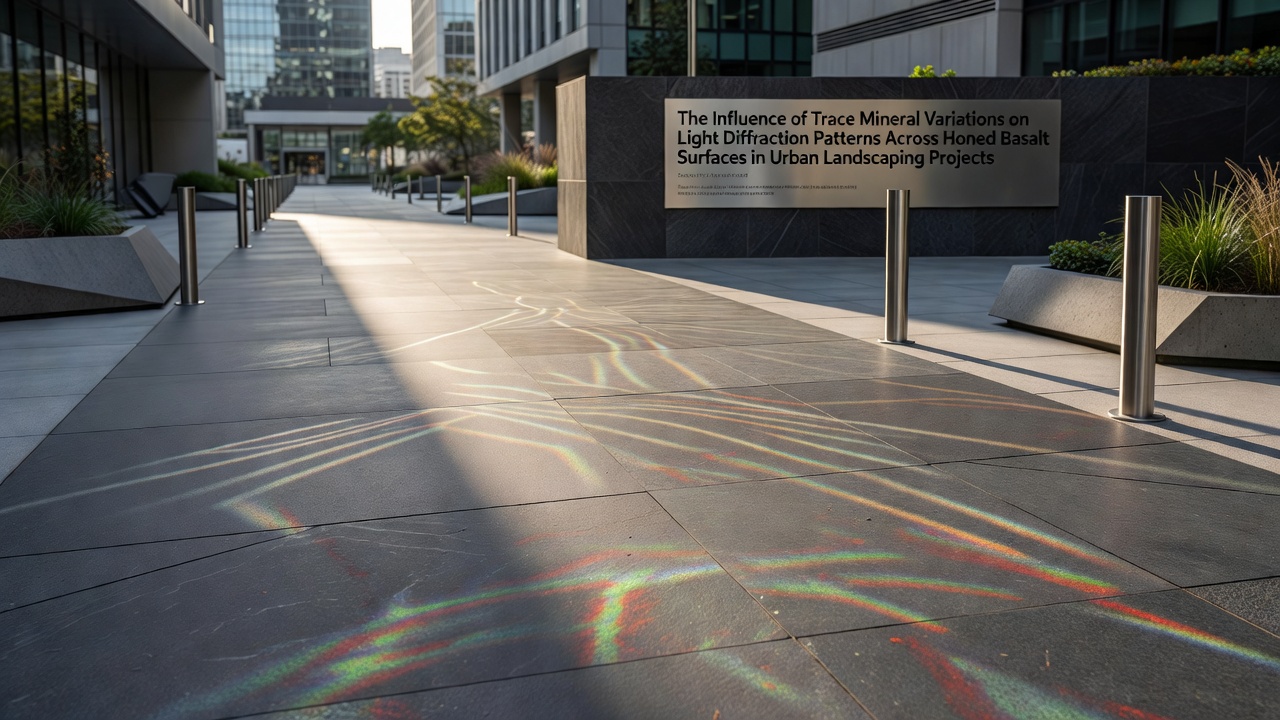
Basalt surfaces appear frequently in urban landscaping because the rock offers durability alongside a naturally textured finish after honing, and trace minerals within the material create distinct interactions with incoming light that alter how patterns form across walkways, plazas, and retaining walls. Researchers have documented these effects through controlled observations of iron oxides, olivine, and pyroxene grains that remain after the honing process removes larger surface irregularities while leaving microscopic variations intact.
Basalt Composition and Trace Mineral Distribution
Basalt forms from cooled lava flows and contains a primary matrix of plagioclase feldspar along with pyroxene and lesser amounts of olivine, yet the distribution of these accessory minerals shifts depending on the quarry source and cooling history. Studies from Geoscience Australia indicate that even small percentages of magnetite or hematite can change local refractive indices, which in turn influences how light waves bend and scatter when they strike a honed plane. Observers note that these mineral grains often cluster in bands or isolated pockets, producing irregular diffraction zones rather than uniform reflectivity across an entire slab.
Honing Techniques and Resulting Surface Topography
Honing employs progressively finer abrasives to create a matte yet smooth finish that removes saw marks without achieving the mirror polish seen on other stones, and this leaves a controlled roughness measured in micrometers that interacts directly with visible wavelengths. Data from laboratory tests show that residual mineral hardness differences cause slight height variations after abrasion, since softer phases wear faster than harder inclusions, and those micro-reliefs become sites where light diffracts at angles determined by the grain size and orientation. In October 2026, urban project teams in several mid-sized cities began specifying tighter honing tolerances after field measurements confirmed that even minor changes in surface profile amplified visible pattern shifts under low-angle sunlight.
Equipment calibration plays a central role here because diamond-impregnated pads must maintain consistent pressure to avoid over-removal around harder grains, and operators monitor coolant flow to prevent heat-induced mineral alteration during the final passes. Those who've examined finished surfaces under scanning electron microscopes report that the resulting topography contains periodic ridges aligned with the original crystal fabric, each ridge acting as a miniature grating that disperses light into faint spectral components visible to the naked eye under certain conditions.
Mechanisms of Light Diffraction on Honed Surfaces
Diffraction occurs when light encounters obstacles or apertures comparable in size to its wavelength, and on honed basalt the combination of mineral boundaries and residual tool marks creates exactly those conditions. Research indicates that iron-rich zones absorb longer wavelengths more readily while magnesium-bearing grains reflect shorter ones, generating localized color shifts that move as the observer changes position. Engineers have measured these effects using goniophotometers, recording that peak diffraction angles correlate directly with the dominant trace mineral present in each sampled area.
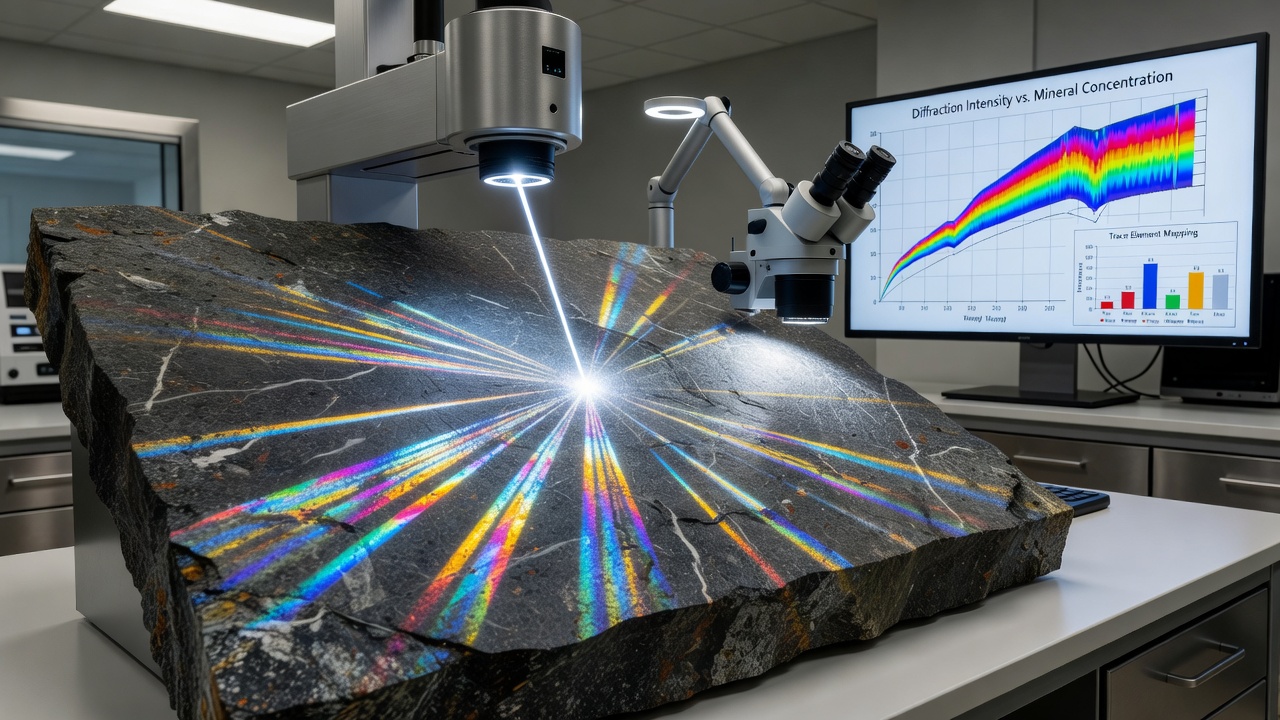
Atmospheric factors compound the mineral-driven patterns because humidity and dust accumulation alter the effective refractive index at the surface boundary, and seasonal changes in solar elevation further modify the observed diffraction intensity. Field reports from completed plazas demonstrate that panels installed with higher olivine content display more pronounced blue-green fringes during morning hours, whereas iron-dominant sections produce warmer tones under afternoon light. These differences remain measurable even after years of exposure, provided the surface receives periodic cleaning that preserves the original honed profile.
Applications in Urban Landscaping Projects
Landscape architects select specific basalt sources once they understand how trace mineral profiles will interact with site-specific lighting conditions, and many now request quarry certificates that list major and minor element concentrations. Municipal guidelines in several regions require documentation of expected diffraction behavior when basalt covers more than 500 square meters of pedestrian space, since inconsistent patterns can affect perceived safety and aesthetic continuity. One study revealed that matching mineral batches across multiple shipments reduced visible seams and maintained uniform light response throughout large installations.
Integration with other materials such as concrete pavers or metal edging demands careful planning because adjacent surfaces reflect light differently and can highlight or mask the basalt diffraction zones depending on their relative heights and finishes. Project teams therefore conduct mock-up panels on site for several weeks before final selection, allowing natural light cycles to reveal how the chosen mineral suite performs under actual conditions rather than laboratory approximations.
Measurement Methods and Ongoing Research
Portable spectrometers and digital imaging systems now allow contractors to quantify diffraction patterns on installed surfaces without laboratory transport, and these tools feed data directly into maintenance schedules that address accelerated wear in high-traffic zones. According to reports from the Geological Survey of Canada, continued monitoring over multiple seasons shows that trace mineral variations remain stable even as overall surface reflectance decreases slightly from weathering, provided the original honing depth exceeded standard specifications. Researchers continue to refine predictive models that correlate quarry assays with on-site performance, aiming to reduce trial-and-error in future urban projects.
Conclusion
Trace mineral variations within honed basalt produce measurable and predictable effects on light diffraction across urban landscaping installations, and these interactions depend on quarry origin, honing parameters, and environmental exposure. Continued data collection from completed sites supplies the information needed to refine material specifications and installation practices, ensuring consistent visual performance in public spaces over time.